Loftia crafting guide: stations, materials and energy
Place the Project Station Milo hands over, gather salvage around Loftia City and spend energy on recipes, tools, stations and furniture.
How does crafting work in Loftia?
You craft at a station on your plot. The opening Loftia City questline gives you a Project Station. That station builds what comes next: the refining, cooking, tailoring and carpentry stations, hand tools, batteries and power equipment.
Each recipe lists its materials and an energy cost.
Where does the Project Station come from?
Milo hands it over at the end of his salvaging errand. Follow the quest marker.
- Meet Milo at his workshop in Loftia City.
- Collect screws and plastic discards around the Scrap Quarter.
- Gather clay at the Construction Site and scrap wire at the Solar Farm.
- Return to Milo, then ride the hot air balloon to your neighborhood island.
- Place the Project Station on your plot and a bed inside the house.
- Craft a Hammer and clear the debris covering the island.
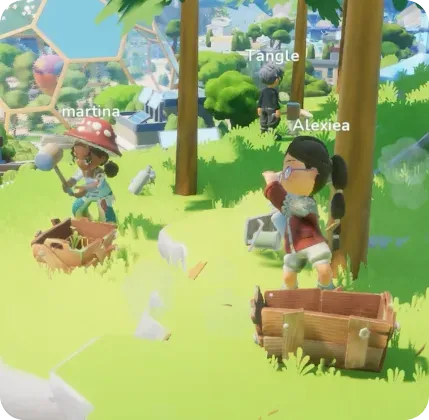
The Hammer is the first tool you make. Breaking debris on the island collects material. Placement stays limited until you buy a Building Permit. The beginner guide covers that part of the sequence.
Which stations can you build at the Project Station?
You do not buy the specialist stations. Each one is a recipe at the Project Station, which is the one station Milo hands over rather than something you build.
| Station | What it produces | Where it appears |
|---|---|---|
| Refining Station | Salvage processed into usable parts | Glider chain with Milo |
| Cooking Station | Meals and drinks from crops | Kun’s request on your island |
| Tailoring Station | Clothing and fabric work | Linda’s First Stitch quest |
| Carpentry Station | Furniture and home pieces | Project Station level 1, Screws 10 and Scrap Wood 10 |
The Project Station itself levels up. Level 2 and level 3 add recipes that consume the previous tier’s output, from bigger solar panels to the Hydrofarm and upgraded tools; the unlock order lists which gate sits where, and the recipe finder shows any recipe’s station level and materials.
You build the Refining Station before the Glider. Milo works on the blueprint while you gather, and the station turns raw salvage into the parts the Glider needs. Later recipes also ask for processed material.
What materials should you gather first?
The opening quests send you to collect these. Scrap wood and metal scraps come later, from the debris your Hammer clears on your own plot.
| Material | Where to find it | First things it builds |
|---|---|---|
| Screws | Scrap Quarter containers and debris | Hammer, Tailoring Station, Refining Station |
| Plastic discards | Scrap Quarter piles | Hammer, Tailoring Station, Watering Can, Rain Collector |
| Clay | Construction Site mounds | Cooking Station, garden beds |
| Scrap wire | Solar Farm | Cooking Station, Refining Station, solar panels |
| Scrap wood | Your island’s debris, broken crates, and the wooden crates around the city perimeter | Garden beds, storage and furniture |
| Metal scraps | Your island’s debris, broken crates | Cooking Station, garden beds, storage and furniture |
City crates show a hammer icon when you are close and respawn quickly, which makes a perimeter loop the reliable way to farm scrap wood when your own plot is cleared. Clay sits in mounds at the Construction Site, and screws and plastic discards come out of Scrap Quarter containers.
Two level-1 recipes turn that salvage into storage: Personal Storage (Scrap Wood 5, Metal Scraps 5, 3 energy) and the Share Box (Plank 2, Metal Plate 2, Glass Cullets 5, 5 energy). Build the first one before your bag has to hold two station tiers of parts; the storage guide covers what to sort where.
Processed versions of these materials — Plank, Metal Plate, Plastic Sheet and the rest — are made at the Refining Station and listed in refined materials.
See salvaging and energy for the power sources. Gridfall is the salvaging district.
Why won’t a recipe start when the materials are there?
Recipes list an energy cost. Solar panels and the other power stations supply it.
Item fragments once stayed uncombined after you collected enough pieces. Patch #1 fixed it, so a complete fragment set now assembles instead of sitting in the bag.
Patch #1 also raised solar output in rain and at night, and later fixes corrected solar and weather readouts on some home islands. If a build stalls on power rather than materials, the energy guide lists the station tiers and battery upgrades.
How does Crafting proficiency grow?
Crafting proficiency levels continue past 5, and Qloud’s Early Access page describes investing points in Perks for the activities you use most.
What does crafting connect to?
- Tools and garden beds come from the Project Station, so farming depends on it from the first seed.
- The Cooking Station is one of those recipes. See cooking.
- Clothing is made at the Tailoring Station. See character customization.
- Furniture and walls are in housing.
- The Glider uses parts made at the Refining Station. See Adventures.
See everyday life for fishing and pets, or the quest order for the story sequence.
Related Articles
guides
Loftia storage: Personal Storage and a full bag
Build Personal Storage at the Project Station, ship crops and cooked dishes instead of hoarding them, and hand fish to the Research Station that lists them.
life
Loftia tailoring: clothing recipes and Bloom cost
The Tailoring Station holds 235 clothing recipes across three levels, and 138 of them cost Bloom as well as fabric. Here is what each tier asks for.
guides
Loftia seeds and watering: tool wheel and refills
Find the seeds a quest gave you in the Tool Wheel, refill the watering can at city stations, and plan around growth timers and the Advanced Watering Can.
Was this helpful?
Thanks for the feedback!